Berlin Poster — Germany Wall Art
Minimalist posters and wall art of Berlin, Germany — premium print on 170 gsm coated silk paper, shipped to 32 countries.
Berlin on the wall, with all its layers
Our designs
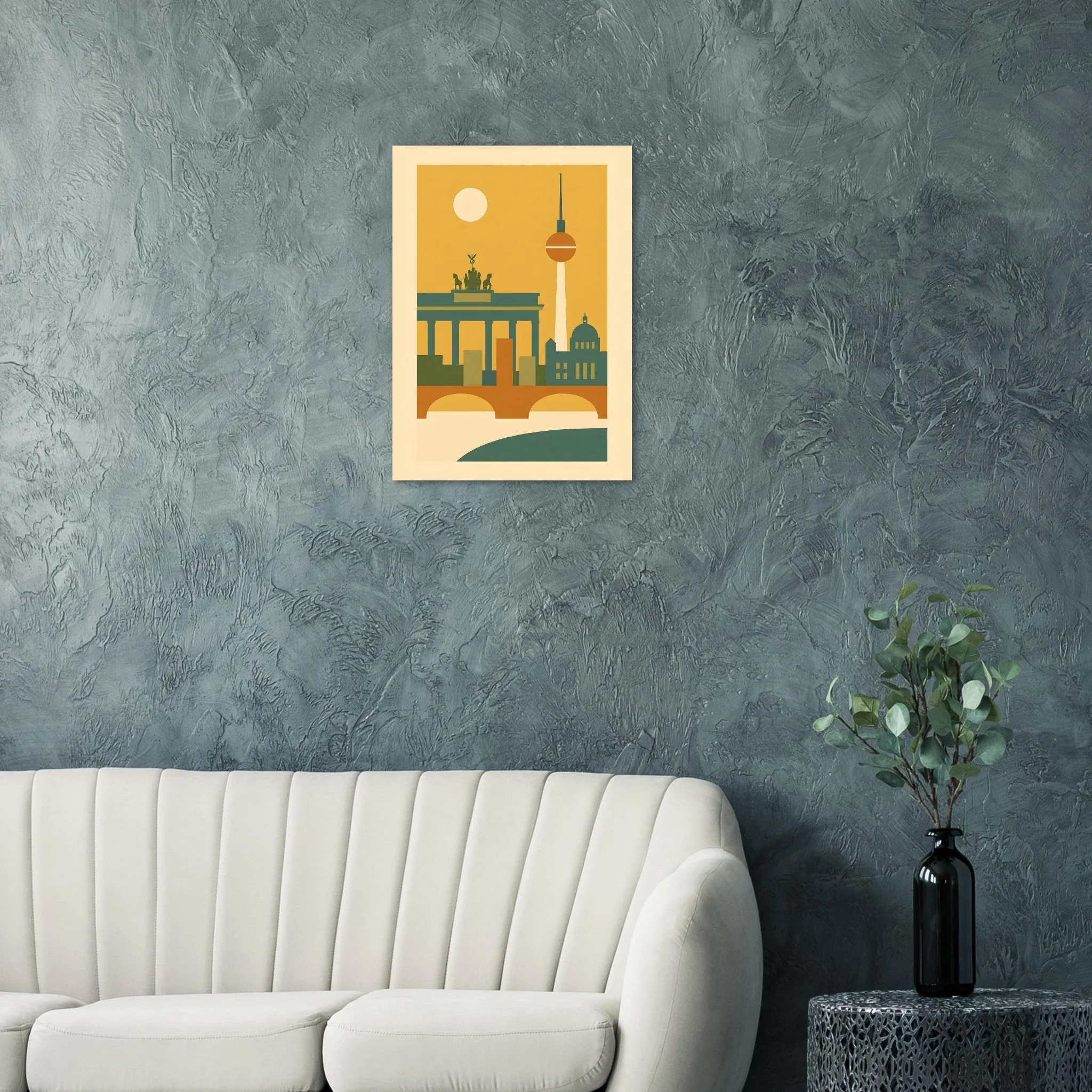
Mid-century modern
from €19
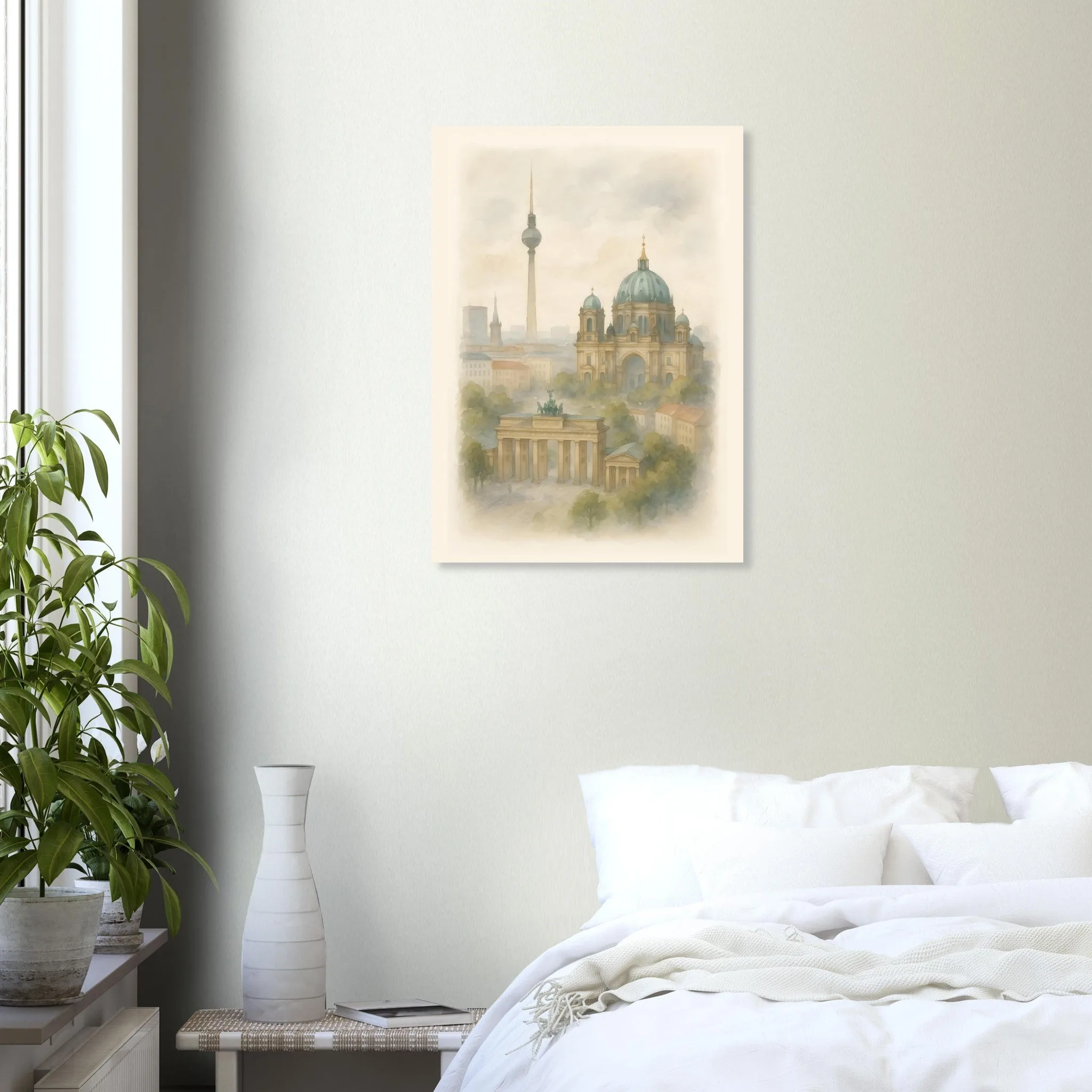
Watercolour landscape
from €19
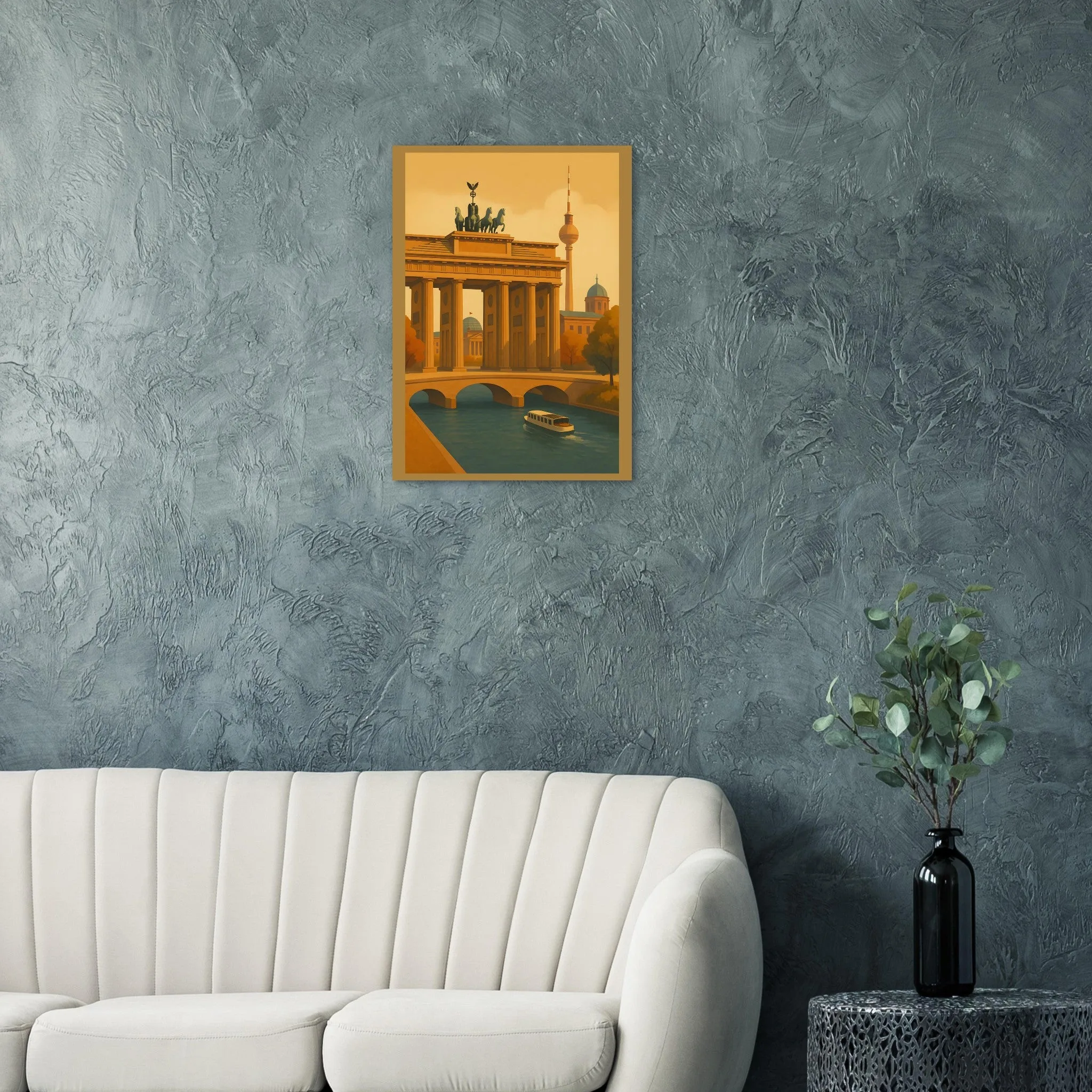
Vintage travel poster
from €19
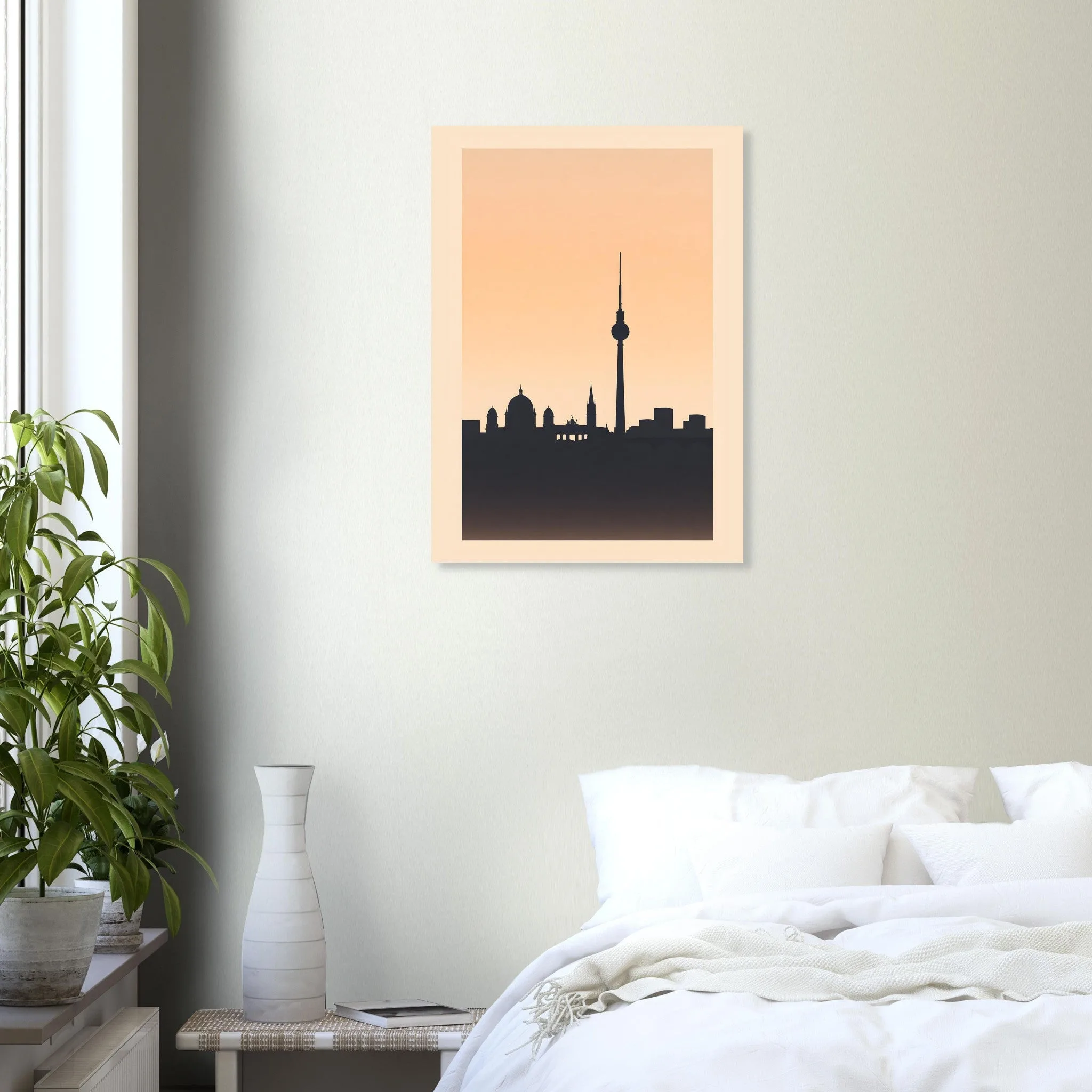
Silhouette skyline
from €19
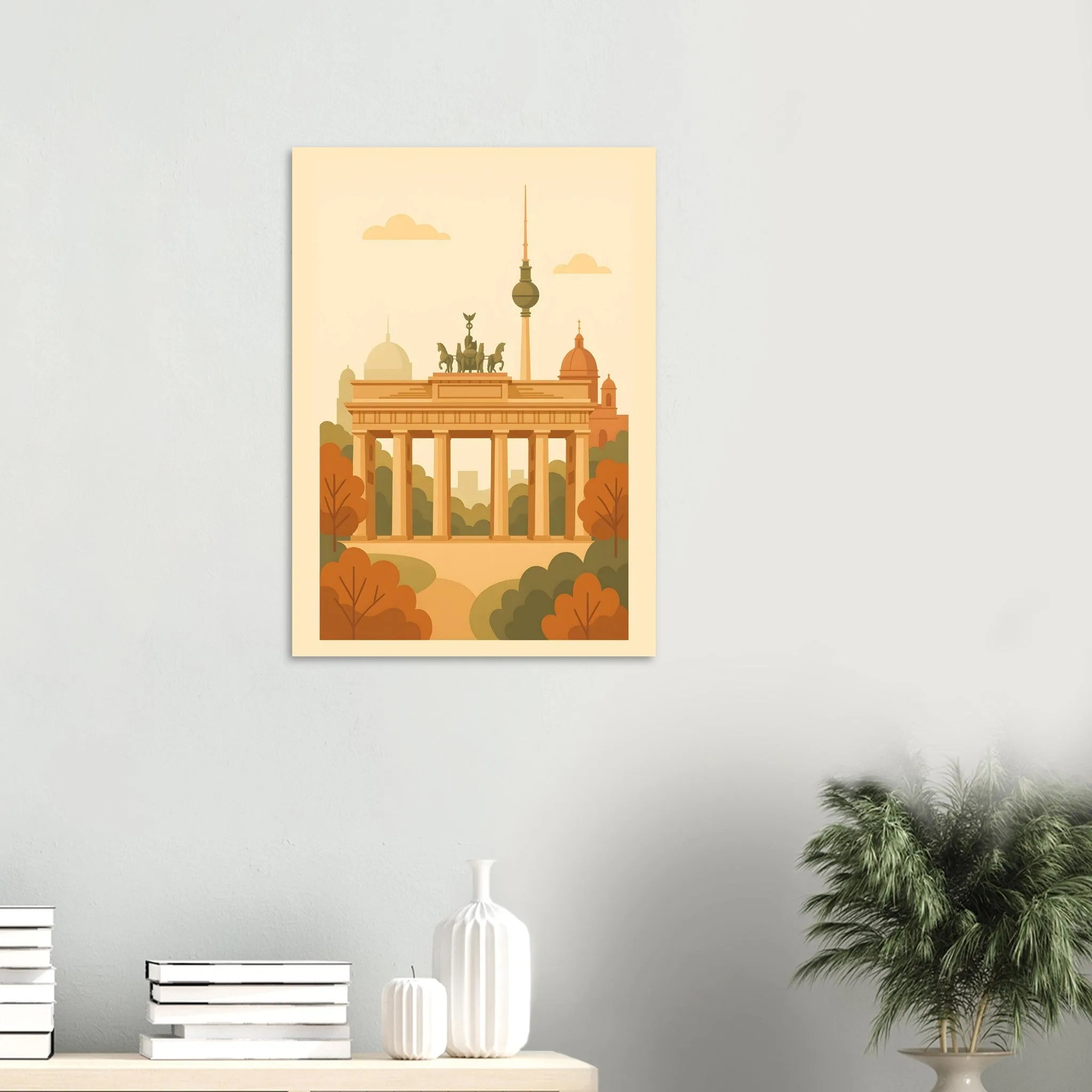
Flat vector illustration
from €19
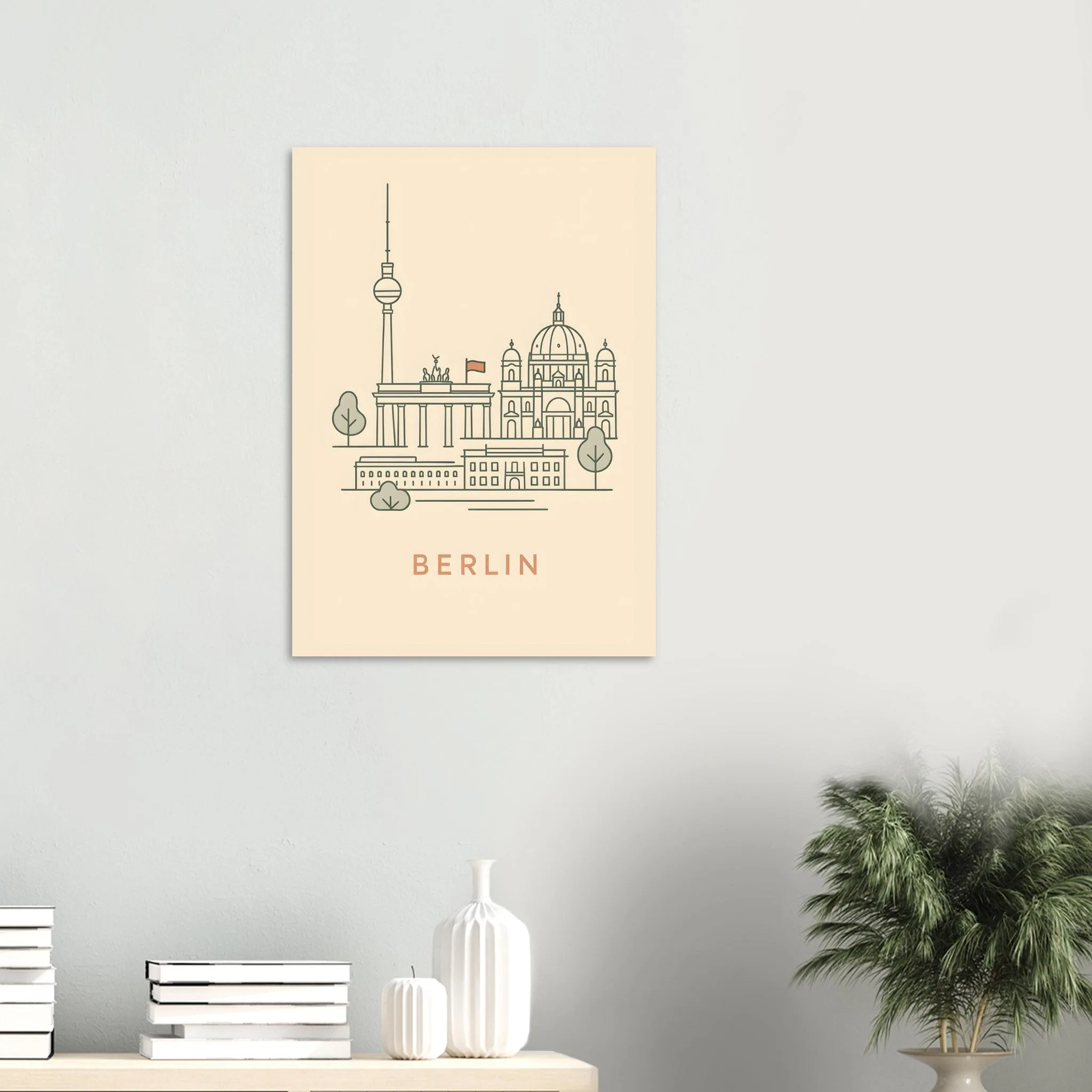
Minimalist line art
from €19
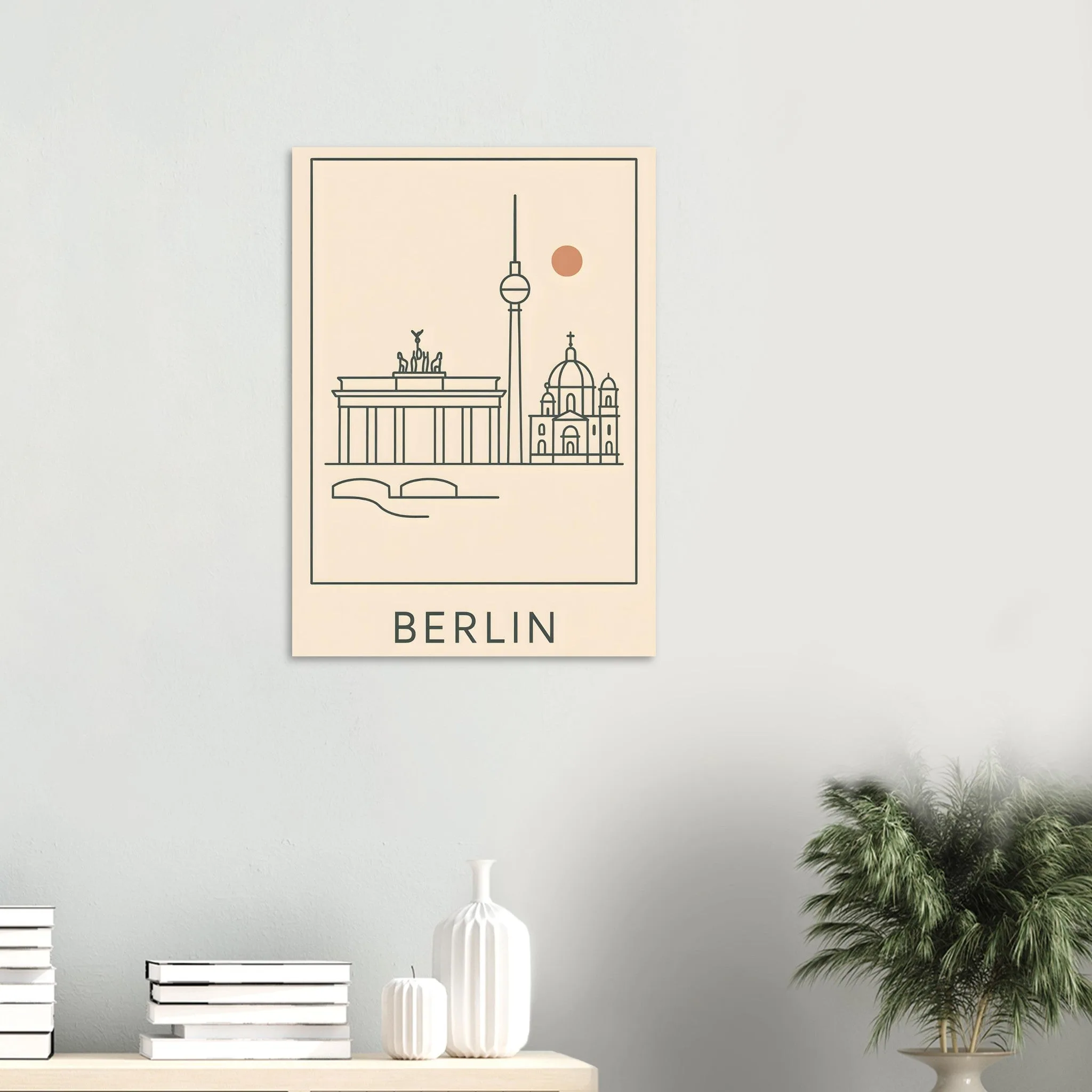
Minimalist line art
from €19
Berlin has a way of staying with you. It might be the echo of footsteps under the trees in Tiergarten, the sight of the Spree catching light beside old stone, or the feeling that the city is always moving between memory and reinvention. It is Germany’s capital and its largest city by area and population, but numbers only tell part of the story. What lingers is the mix: grand avenues and quiet courtyards, hard history and everyday ease, a city that never quite settles into one mood.
Founded in 1244, Berlin has had centuries to gather contrasts. It is now home to around 4.3 million people, spread across 891.12 square kilometres, and sits at roughly 34 metres above sea level, surrounded by Brandenburg. The city’s scale is part of its character, yet it still feels intimate in the way familiar places do: a tram line you once took often, a corner café, a station platform at dusk, the long light over museum façades and apartment blocks.
Berlin also carries the particular energy of a place that belongs to both the everyday and the symbolic. It is the capital of Germany, the largest city in the European Union by population within city limits, and a city made of twelve districts, each with its own rhythm. That mix of civic weight and lived-in texture is what makes Berlin such a compelling subject for wall art: not a single image, but a place with layers.
Berlin is one of those cities that people remember in fragments. The curve of the river, the wide streets, the sudden calm of a park after a noisy night, the way history sits in plain sight without asking to be admired. It is a city of crossings and returns. The Spree runs through it, and nearby waters, lakes, and woodland soften the edges of a capital that can feel brisk, even stern, from the outside. Yet Berlin is also full of small human details: bicycle bells, bakery queues, winter scarves, summer beer gardens, the private rituals of a city lived in rather than simply visited.
Its history gives the city its depth. Berlin was first recorded in 1244, and over time it became not only the seat of government but also a place where Germany’s cultural and political tensions were often made visible. That history is present in the city’s architecture and in its atmosphere: the stately formality of some streets, the rougher honesty of others, the sense that nothing here is entirely separated from what came before. Even without naming specific monuments, Berlin feels recognisable in its combinations — stone and glass, old facades and modern lines, open space and compressed memory.
There is also the matter of scale. With an area of 891.12 square kilometres, Berlin is Germany’s largest city by area, and its population of about 4.3 million makes it one of Europe’s great urban centres. Yet the city rarely reads as a single block. It is made of districts, neighbourhood habits, and local accents that change as you move across it. The Berlin dialect, softened in some places and sharper in others, carries the city’s directness: a certain dry humour, a practical rhythm, a refusal to overstate. Even if you only heard it once, it can stay with you like the sound of a street you used to know.
That is part of Berlin’s appeal for anyone choosing art connected to place. Some cities are remembered for a single skyline or a single monument; Berlin is remembered for atmosphere. For one person it may be the view across Museum Island in a pale morning, for another the broad civic spaces near the centre, for someone else the quieter edges where trees, water, and housing blocks meet. The city sits at an elevation of about 34 metres, but emotionally it can feel much larger: a capital with room for solitude, movement, and reinvention all at once.
Berlin is also shaped by the fact that it is both city and state, one of the federal states of Germany. That dual identity gives it a distinctive civic confidence. It stands in contrast to Brandenburg, which surrounds it, and even its relationship with Potsdam hints at how closely urban life and regional life are woven together here. Around the city, the metropolitan region extends far beyond the centre, and the wider Berlin-Brandenburg area holds roughly 6.2 million people. In other words, Berlin is never only the postcard version of itself. It is a lived landscape, a working capital, and a place where many people carry personal histories: former residents, students, expats, commuters, and families whose memories are tied to specific streets and seasons.
For that reason, Berlin wall art often resonates in a quiet, personal way. It can recall a first apartment, a semester abroad, a childhood neighbourhood, or a city break that felt unexpectedly meaningful. It can also simply bring a certain visual calm into a room: the geometry of streets, the balance of water and stone, the restrained confidence of a place that has seen enough to know that understatement can be powerful. Berlin does not need to be sentimental to feel emotional. Its beauty often lies in being exact rather than ornate, and in letting the viewer supply the memory.
Choosing a Berlin poster for your home
Berlin suits many kinds of interiors because the city itself contains so many moods. In a living room, a larger format can hold the wall the way a panoramic city view holds a horizon, especially above a sofa or sideboard. In a hallway or study, a smaller print can feel more intimate, like a remembered corner of the city rather than its full sweep. A4 works well when you want a quiet accent, perhaps on a shelf or in a narrow space. A3 and 30×40 cm are often the easiest choices for bedrooms, offices, and gallery walls. If you have a larger blank wall, 50×70 cm gives Berlin enough room to breathe.
The look of the room matters too. Warm interiors with oak, brass, linen, or earthy textiles tend to soften Berlin’s urban lines beautifully, especially when the artwork uses a muted palette. Cooler interiors — white walls, black metal, concrete, pale wood — can take a more graphic treatment and let the city’s clean geometry do the work. Framed or unframed both work, depending on whether you want a more finished presence or a lighter, more casual feel. A frame can make the piece feel like a keepsake; unframed paper keeps it relaxed and contemporary.
Berlin posters as gifts
A Berlin poster is often at its best as a gift because it carries meaning without needing much explanation. Former residents usually recognise the feeling immediately: the city they left behind, or left and returned to in memory. Travellers may see it as a reminder of a good trip and the particular mood of being there — not just the landmarks, but the rhythm of the days. Expats often appreciate a piece of home that can live on a wall far away. And for locals, Berlin art can be a quiet form of pride, something that says the city is not only where they live, but part of who they are.
It can work for a housewarming, when someone is still making a place feel like their own. It can be thoughtful for a birthday, especially if the city has a shared history between giver and recipient. At Christmas, it becomes a personal present that feels considered rather than generic. And as a retirement gift, Berlin wall art can mark a transition with something calm and lasting, a reminder of years spent in a city that has shaped daily life in ways both large and small.
What makes our Berlin posters different
What matters most in city art is not only the image, but whether it feels true. Our Berlin posters are created with verified geographic and historical facts in mind, so the work stays rooted in the real city rather than in vague urban clichés. Berlin’s scale, its founding date, its position within Germany, and its character as both capital and state are part of what gives the subject its weight. The result is a design language that aims to feel local, restrained, and respectful.
We also print locally, on 170 gsm FSC-certified semi-gloss silk paper with archival inks, so the finish feels substantial without glare. The palette is kept warm and minimalist, which helps the artwork sit naturally in contemporary interiors and in homes where colour is already doing a lot of work. Nothing about Berlin needs to be overexplained. The right print should leave room for memory.
Berlin is not a city that asks to be simplified. It is better kept in layers — the river, the districts, the history, the light.
Sizes and prices
If you are choosing by wall size as much as by feeling, the formats make practical sense as well. A4 starts at €19 and is ideal for smaller spaces or for mixing into a gallery wall. A3 is €29 and offers a little more presence without taking over the room. 30×40 cm is €34 and works especially well in standard frames and medium-sized walls. 50×70 cm is €49, a strong choice when you want Berlin to become a focal point rather than a detail.
That range makes it easier to match the print to the room you already have in mind. A compact bedroom, a home office, a bright kitchen, a hallway that needs a point of focus — each can take Berlin differently. What stays constant is the city itself: broad, layered, and quietly magnetic.
Frequently asked questions
What sizes do Berlin posters come in?
Our Berlin posters come in four standard sizes: A4 (21×30 cm) from €19, A3 (30×42 cm) from €29, 30×40 cm from €34, and 50×70 cm from €49. All sizes are printed on 170 gsm semi-gloss FSC-certified silk paper.
How long does shipping take?
We print locally via Gelato in 32+ countries. In Europe, your order typically arrives within 3–5 business days of purchase. Free EU shipping on every order — no minimum.
What's the print quality like?
We print on 170 gsm FSC-certified semi-gloss silk paper using archival inks. Colours are warm, muted, and lightfast for years — made to stay on a wall, not fade in a season.
Can I order a framed Berlin poster?
Framed options are coming soon. For now, we ship unframed posters — our standard sizes fit common off-the-shelf frames from IKEA, HAY, Desenio, and others.
Where do the designs come from?
Each Berlin design begins with verified facts from open geographic sources — Wikipedia, OpenStreetMap, GeoNames. We only depict what's historically and culturally rooted in a place, never inventions.
Can I return my poster if I'm not happy?
Yes. We offer 30-day free returns. If your poster doesn't feel right once it's on your wall, send it back for a full refund.