Essen Poster — Germany Wall Art
Minimalist posters and wall art of Essen, Germany — premium print on 170 gsm coated silk paper, shipped to 32 countries.
Essen wall art with Ruhr character
Our designs
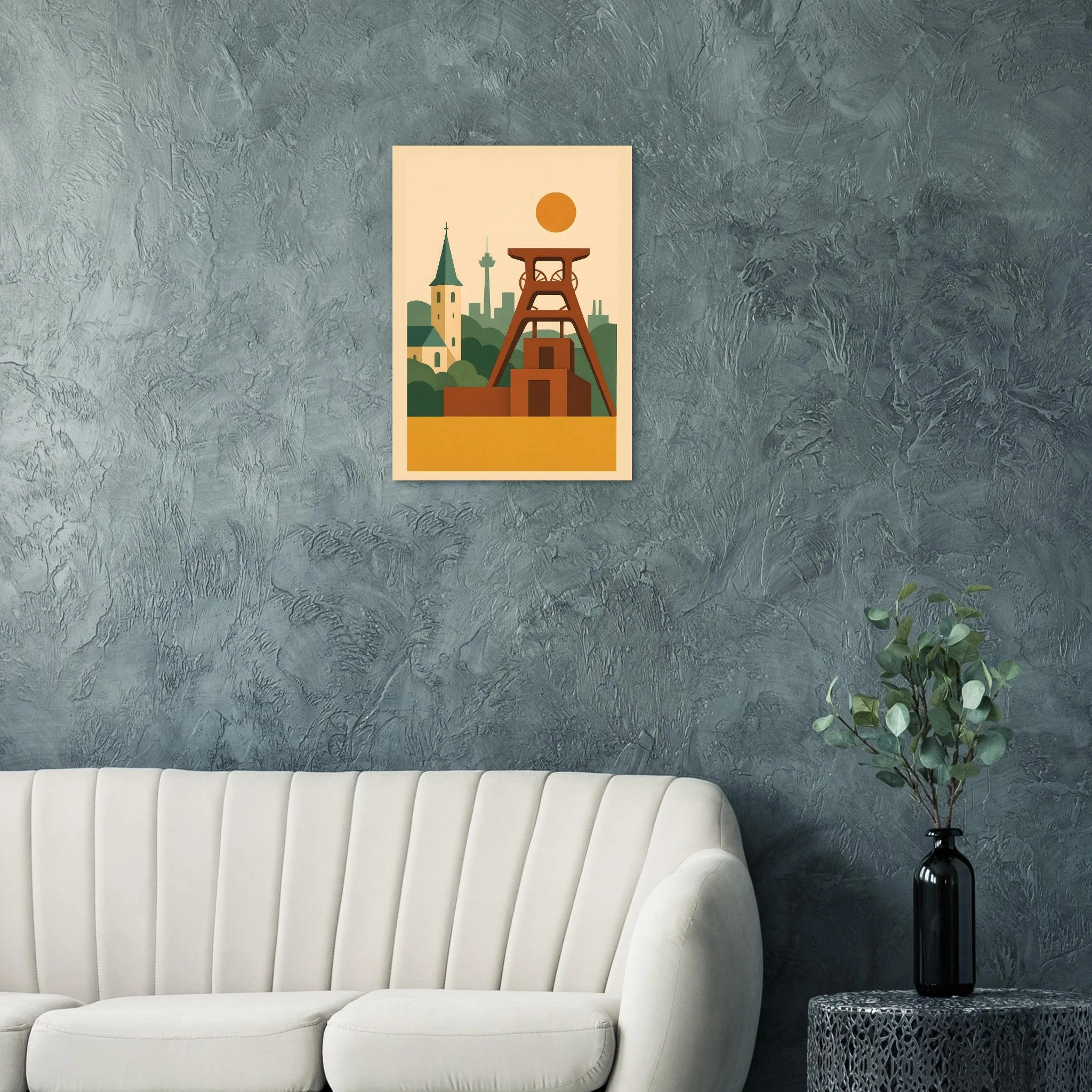
Mid-century modern
from €19
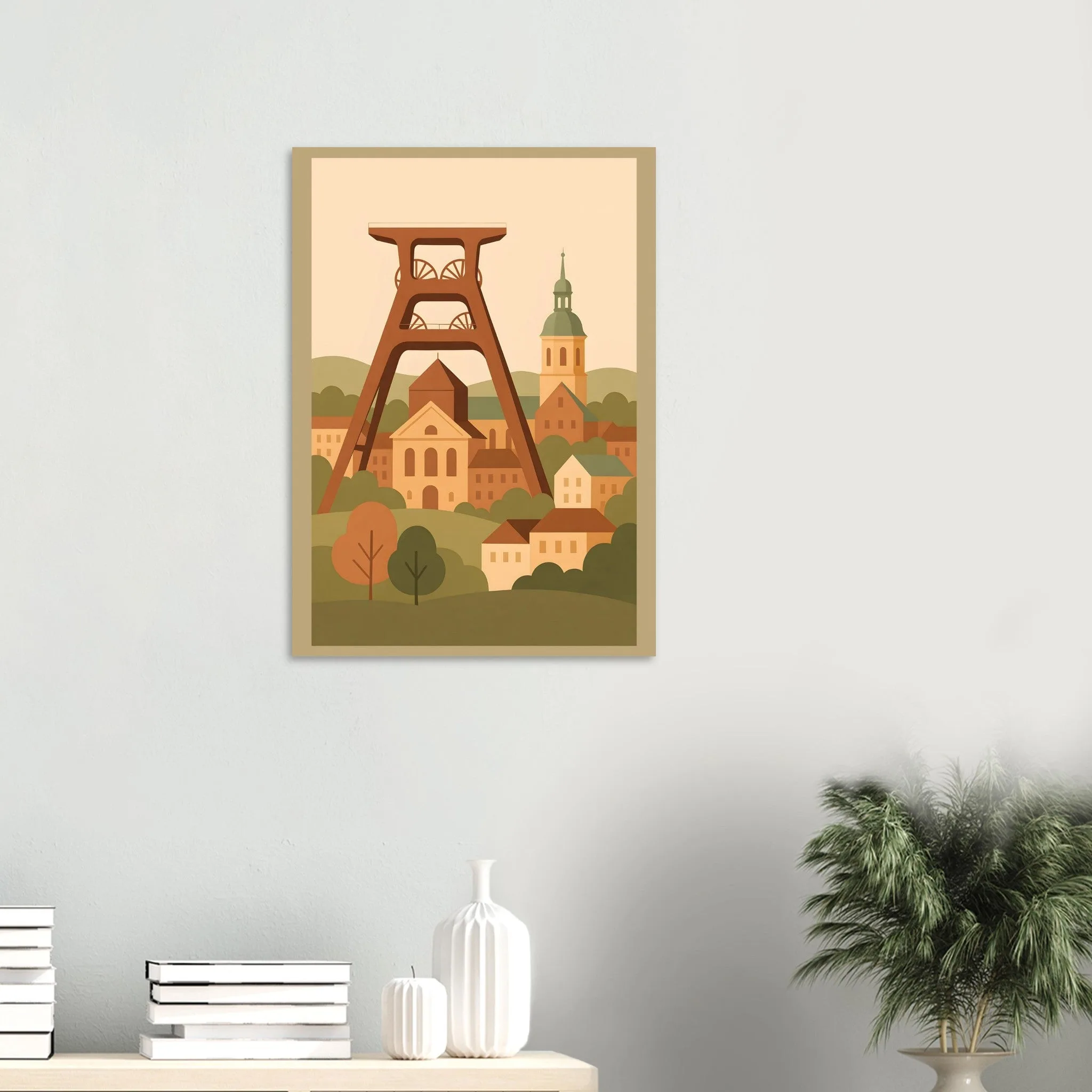
Flat vector illustration
from €19
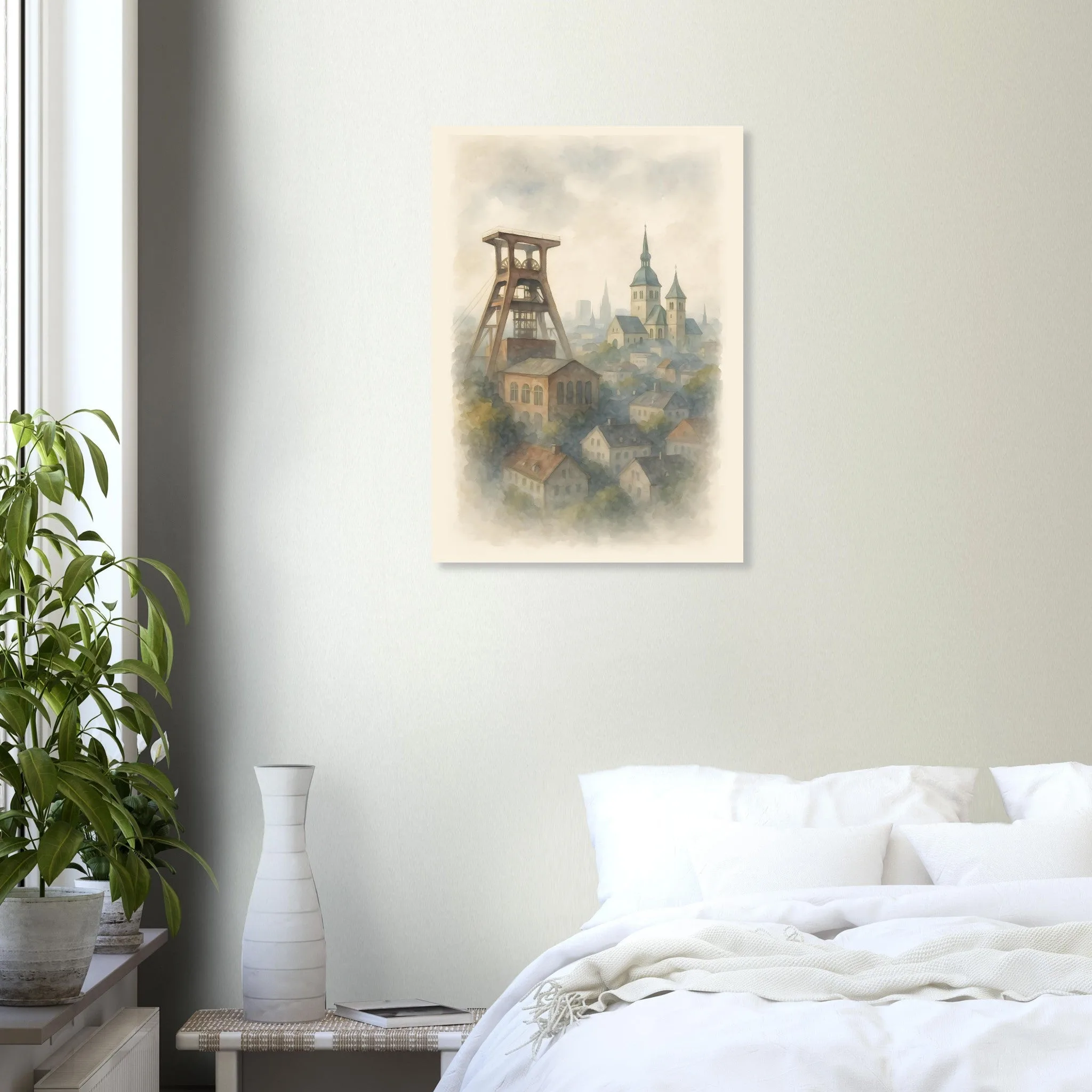
Watercolour landscape
from €19
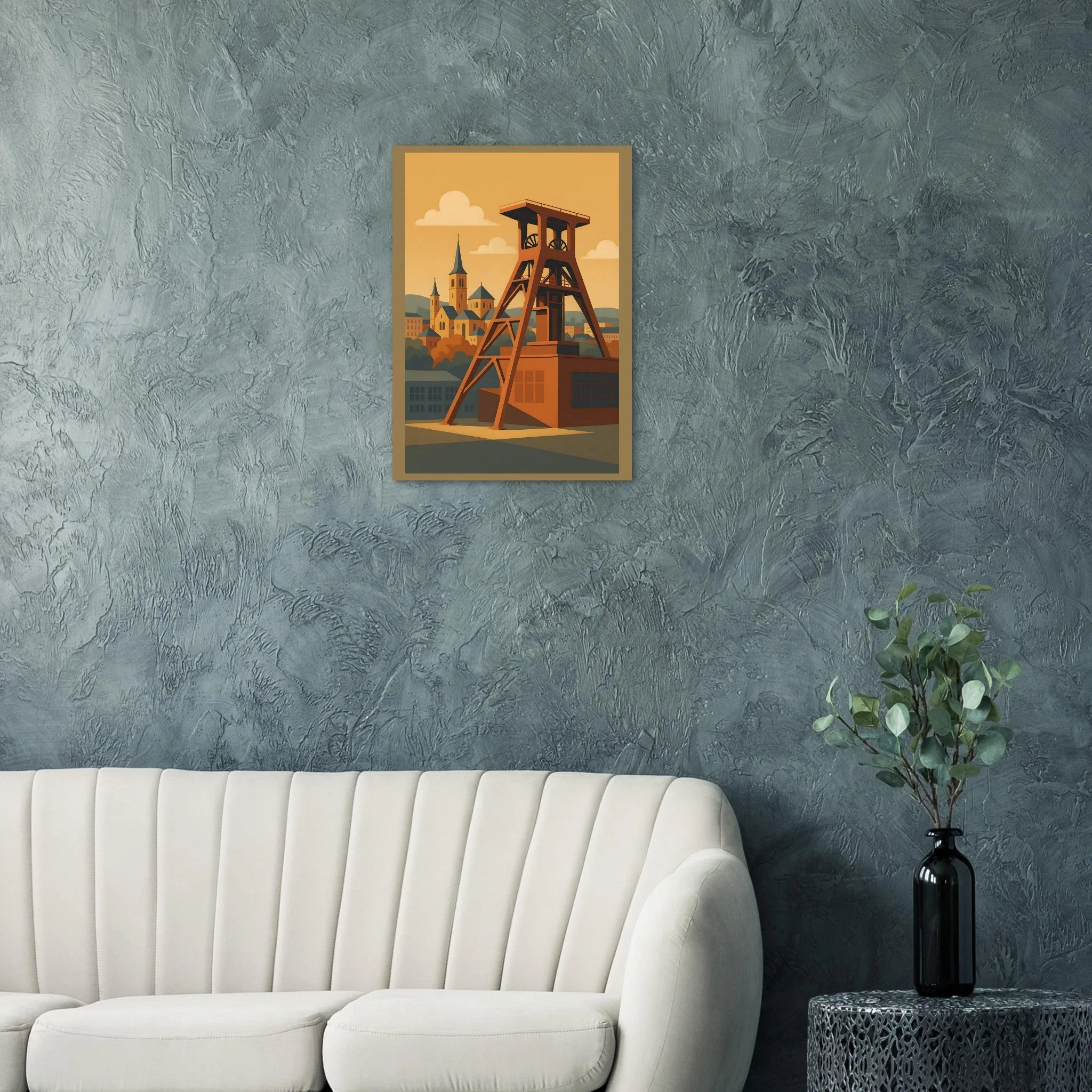
Vintage travel poster
from €19
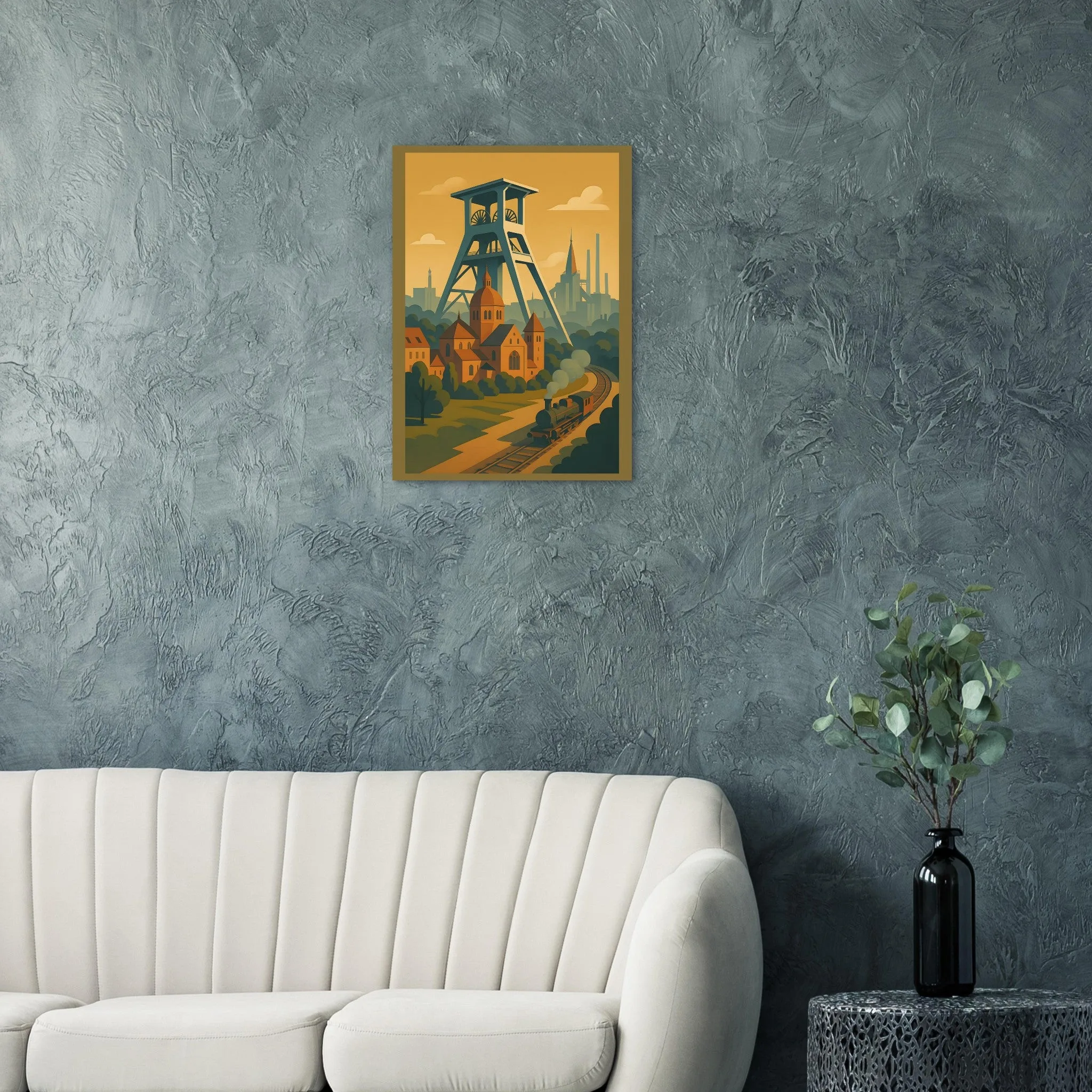
Vintage travel poster
from €19
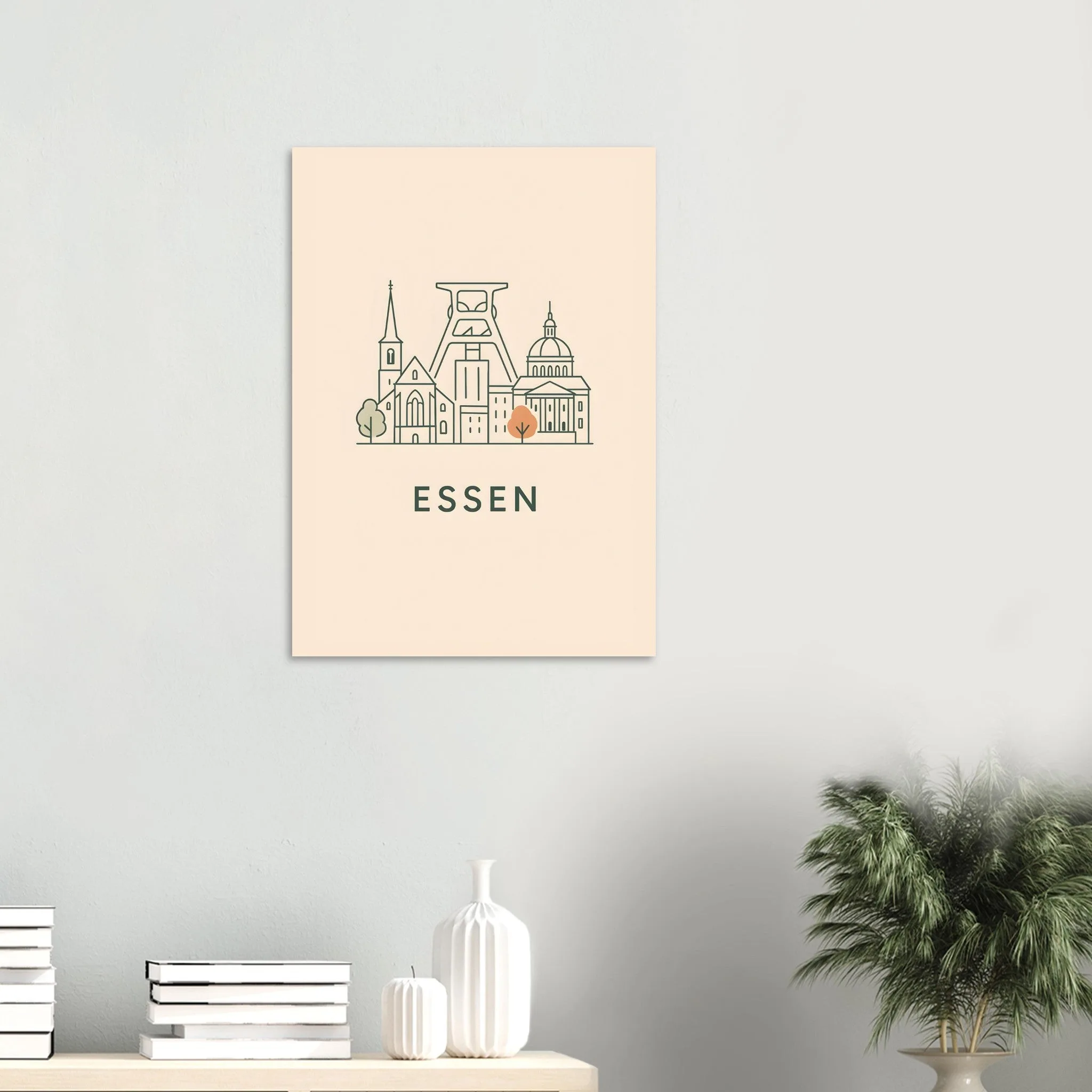
Minimalist line art
from €19
Essen has a way of feeling both rooted and in motion. In the middle of the Ruhr, and part of the wider Rhine-Ruhr region, it sits at a crossroads of industry, culture, and everyday life. With a population of 677,568 and an area of 210.34 km², it is a city that stretches wide enough to hold many different memories: station forecourts on grey mornings, quiet residential streets, the long lines of roofs, and the sense of a place that has grown through work as much as through habit.
At 116 metres above sea level, Essen is not a city of dramatic heights, but of texture. Its character is shaped less by one single view than by the feeling of moving through a city that many people know well and still rediscover. It is the central city of the Ruhr and, after Dortmund, the region’s second-largest. That centrality gives it a particular confidence. Even now, it is often called the Ruhr’s “secret capital” — a phrase that fits the city’s understated self-image.
There is also a sense of institution and continuity here. Essen is home to the University of Duisburg-Essen, sits within the Regierungsbezirk Düsseldorf, and has long been associated with major industry and business. Yet the city is not only about scale or economics. It carries the memory of post-industrial change, of neighbourhoods adapting, and of a landscape where the old and the new continue to sit side by side. That mix is what many people remember first: not a single landmark, but a mood.
Essen is one of those cities that reveals itself gradually. It is central in the Ruhr, and its role in the wider Rhine-Ruhr metropolitan region has made it feel connected to many directions at once. People pass through it for work, study, family visits, or a concert evening, and then later realise how clearly the city stayed with them. The memory is rarely flashy. More often it is a colour, a street pattern, a skyline seen from a tram window, or the quiet authority of a city that has learned how to carry its past without freezing in it.
The city’s scale matters to that feeling. With 677,568 residents, Essen is large enough to be varied, yet it still has the recognisable rhythm of a place where districts, routes, and habits matter. Its 210.34 km² spread means there is room for contrasts: busy inner-city streets and calmer edges, older industrial memory and university life, civic institutions and everyday routines. As the seat of the Diocese of Essen since 1958, it also has a layer of cultural and religious significance that sits naturally alongside its industrial identity. These are not separate stories so much as overlapping ones, which is often how a city becomes memorable.
For many people, Essen is inseparable from the Ruhr itself. It is the region’s central city and, after Dortmund, its second-largest. That position has given it a kind of quiet prominence, the sort that does not always announce itself. The city is often described as the Ruhr’s “secret capital,” and the phrase feels apt because Essen rarely performs its importance loudly. Instead, it shows it in the everyday: in the density of urban life, in the long afterlife of industrial development, in the presence of large employers and universities, and in the way the city continues to anchor the region around it.
The local atmosphere is shaped by that working history, but also by the ordinary details that make a city feel lived-in. Essen belongs to the cultural area of Rhineland, and although it is deeply Ruhr in character, there is a certain softness in its urban texture too — a practical warmth, a directness, a refusal to overstate. People who know the city often remember it through small things: the way the light falls across broad streets, the sense of movement around the centre, the mix of older and newer architecture, the feeling that the city is always in conversation with its own past. That is why Essen resonates so strongly as a place people return to in memory.
There is also something particularly human about the way Essen sits within North Rhine-Westphalia. It is the fourth-largest city in the state, after Cologne, Düsseldorf, and Dortmund, and the tenth-largest city in Germany. Those are important facts, but they only tell part of the story. What people actually remember is the atmosphere of a city that has played a major role in the region without losing its everyday scale. Essen is not a place of grand gestures. It is a place of continuity, of urban confidence, of streets and districts that feel known. That is often what makes city art feel personal: not perfection, but recognition.
For anyone who has lived here, studied here, worked here, or simply passed through and stayed with the feeling, Essen carries a particular kind of belonging. It may be tied to family roots, to a first flat, to years at the University of Duisburg-Essen, or to the memory of a city that felt grounded and real. That emotional charge is exactly what makes Essen such a natural subject for wall art: it is specific enough to mean something, and open enough to fit into different lives.
Choosing a Essen poster for your home
The right Essen wall art depends less on rules than on the room you want to give a sense of place. In a living room, a larger format can hold its own above a sofa or sideboard, especially if the wall is generous and the rest of the space is calm. In a hallway or study, a smaller print can work like a memory marker — something you notice on the way past, the way you might notice a familiar street corner in the city itself. A bedroom often benefits from something quieter, with enough space around it to let the image breathe.
Style also matters. Essen’s urban character pairs naturally with warm interiors that use oak, beige, terracotta, or soft brown tones, especially if you want the city’s industrial history to feel grounded rather than stark. In cooler interiors — greys, white walls, steel, black accents — the city’s cleaner lines and metropolitan feel can look especially sharp. Framed prints tend to feel more finished and architectural, while unframed versions are lighter and easier to mix into a gallery wall. If you are choosing for a narrow wall, a portrait format can create height; for a wider space, landscape proportions often feel more natural.
Essen posters as gifts
An Essen poster is often at its best as a gift because it carries a private meaning without needing an explanation. Former residents recognise their own streets and routines in it. People who studied here may see the city as the backdrop to a formative chapter. Travellers often want something more lasting than a souvenir, something that brings back the atmosphere rather than a single monument. And for locals, a city print can be a quiet expression of pride — not loud, just sure of itself.
That makes Essen wall art a thoughtful choice for housewarming gifts, birthdays, Christmas, or a retirement present. It can mark a move to a new apartment, a return after years away, or simply a wish to keep a place close. Because Essen is tied to both memory and movement, it suits gifts that are personal but not overly formal. It feels especially apt for someone who speaks of the Ruhr with affection, or who has a sense of belonging that is rooted in the city’s everyday landscape rather than in one famous landmark alone.
What makes our Essen posters different
Our Essen posters are designed to feel grounded in the place itself. We focus on verified geographic and historical facts, so the city is represented with care and without embellishment. That means the artwork draws on Essen as it is known: its position in the Ruhr, its role in North Rhine-Westphalia, its scale, and the character that comes from being a central city with a long industrial and civic history. The result is a cleaner, more honest connection to memory.
We also print locally on 170 gsm FSC-certified semi-gloss silk paper with archival inks, which gives the surface a soft, contemporary finish and helps the colours stay calm rather than glossy. The palette is intentionally warm and minimalist, made to sit easily in real homes — whether the room leans modern, classic, or somewhere in between. If you prefer a framed look, that can add presence; if you want something lighter, an unframed print keeps the focus on the city itself. In either case, the aim is the same: to make the place feel familiar again.
Sizes and prices
The formats are chosen to suit different spaces without making the decision complicated. A4 starts from €19, A3 from €29, 30×40 cm from €34, and 50×70 cm from €49. Smaller sizes work well for shelves, narrow walls, and layered gallery arrangements, while the larger format is a strong choice for a single statement wall or a room that needs one clear focal point. If you are matching a poster to an existing frame, the 30×40 cm and 50×70 cm options are often the easiest to place.
However you choose to hang it, Essen works beautifully as a city print because it is not only about what can be seen, but about what can be remembered. The city’s 116-metre elevation, its wide urban footprint, its role in the Ruhr, and its place within the Rhine-Ruhr region all contribute to that feeling of breadth and belonging. It is a city with weight, but also with warmth — and that is often exactly what people want to bring back onto the wall.
Frequently asked questions
What sizes do Essen posters come in?
Our Essen posters come in four standard sizes: A4 (21×30 cm) from €19, A3 (30×42 cm) from €29, 30×40 cm from €34, and 50×70 cm from €49. All sizes are printed on 170 gsm semi-gloss FSC-certified silk paper.
How long does shipping take?
We print locally via Gelato in 32+ countries. In Europe, your order typically arrives within 3–5 business days of purchase. Free EU shipping on every order — no minimum.
What's the print quality like?
We print on 170 gsm FSC-certified semi-gloss silk paper using archival inks. Colours are warm, muted, and lightfast for years — made to stay on a wall, not fade in a season.
Can I order a framed Essen poster?
Framed options are coming soon. For now, we ship unframed posters — our standard sizes fit common off-the-shelf frames from IKEA, HAY, Desenio, and others.
Where do the designs come from?
Each Essen design begins with verified facts from open geographic sources — Wikipedia, OpenStreetMap, GeoNames. We only depict what's historically and culturally rooted in a place, never inventions.
Can I return my poster if I'm not happy?
Yes. We offer 30-day free returns. If your poster doesn't feel right once it's on your wall, send it back for a full refund.